 Backgammon
Part Three — Choose a plan
Lesson 17 — Build a prime
Open the bookA prime is a row of consecutive made points. It limits the landing places available to an opposing checker trying to escape.
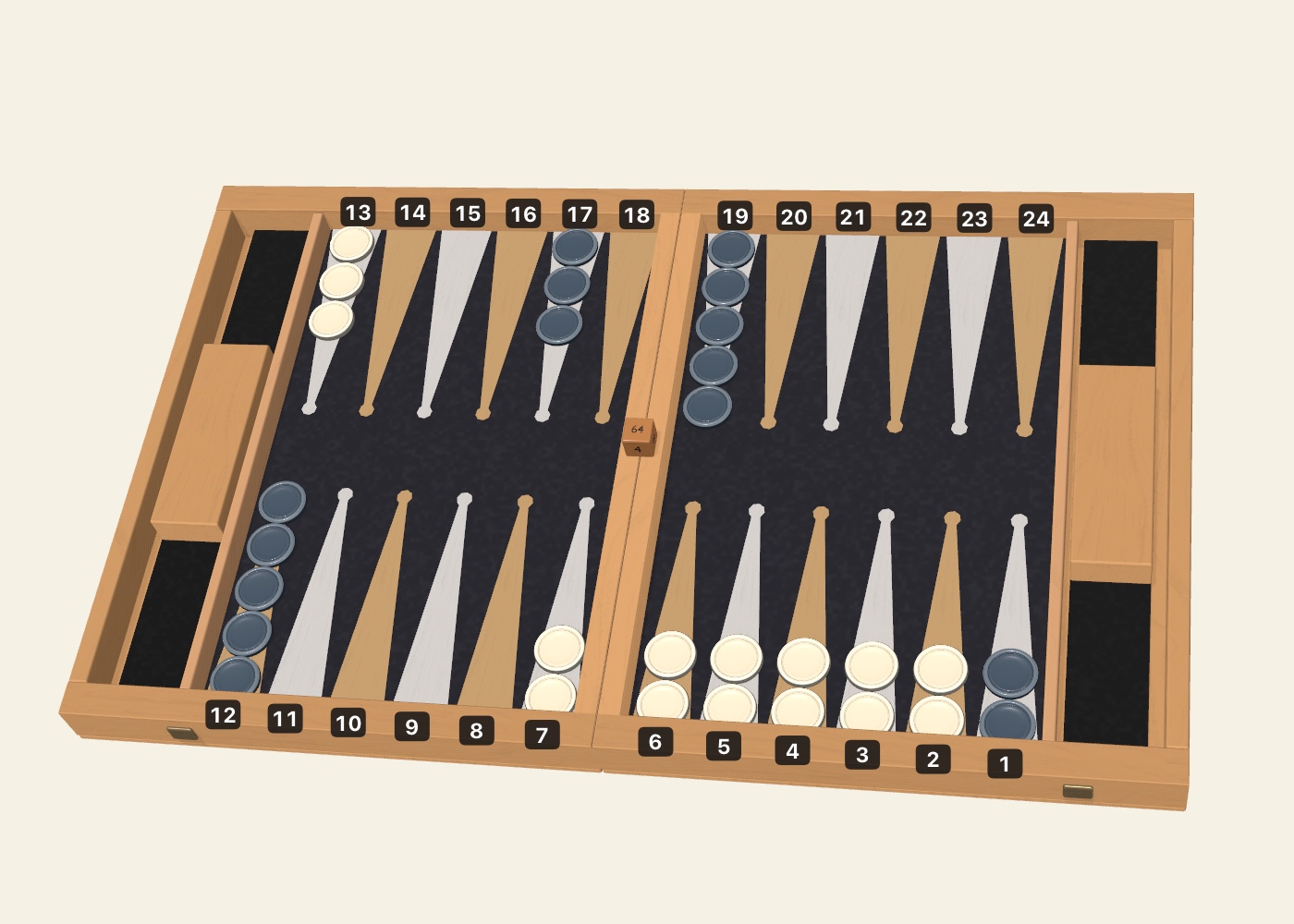
In Figure 16, White holds points 2 through 7. Black has two checkers on point 1. This six-point prime blocks their path completely: a die can move at most six points, and every possible first landing from point 1 is closed.
Black cannot combine a 6 and a 1 to leap across it. The first landing is still required. Nor can Black use doubles to ignore the blocked intermediate landings.
A shorter prime is useful but may be jumped with the right number. Its position matters: a prime behind the opposing checkers is not trapping them. Follow the opponent's direction and identify what is actually in front of them.
Building a prime is only half the task. You need to keep it long enough to profit from it. Spare checkers provide waiting moves; a board with no flexibility may have to open its own barrier.
When both sides are building primes, the game can become a contest of escape and timing. Notice which trapped checkers can move toward the edge of the barrier before it closes.
Figure 16. Six closed landing points. Black's checkers on point 1 cannot pass White's prime while all six points remain made.
Board position
| Point × checkers | Bar | Borne off | |
|---|---|---|---|
| White | 2 × 2, 3 × 2, 4 × 2, 5 × 2, 6 × 2, 7 × 2, 13 × 3 | 0 | 0 |
| Black | 1 × 2, 12 × 5, 17 × 3, 19 × 5 | 0 | 0 |
Your turn. Does a six-point prime prevent every opposing checker on the board from moving?
Explanation. No. It traps checkers behind it. Black's checkers beyond the prime can still move if the dice and other landing points permit.