 Backgammon
Part One — Play your first game
Lesson 3 — Read the dice as separate moves
Open the bookA die tells you how many points a checker moves. Each point of movement is one pip. From point 8, a 3 takes White to point 5. Do not count the starting point as the first step: count 7, 6, 5.
The two dice give you separate moves. With a 3 and a 1, you might move one checker three points and another checker one point. You may also move the same checker twice, provided each landing is legal.
A point is open to you when it is empty, occupied by your own checkers, or occupied by exactly one opposing checker. A point occupied by two or more opposing checkers is closed to you.
You can pass over closed points. You cannot land on them. When you move one checker using both dice, its intermediate landing matters just as much as its final landing.
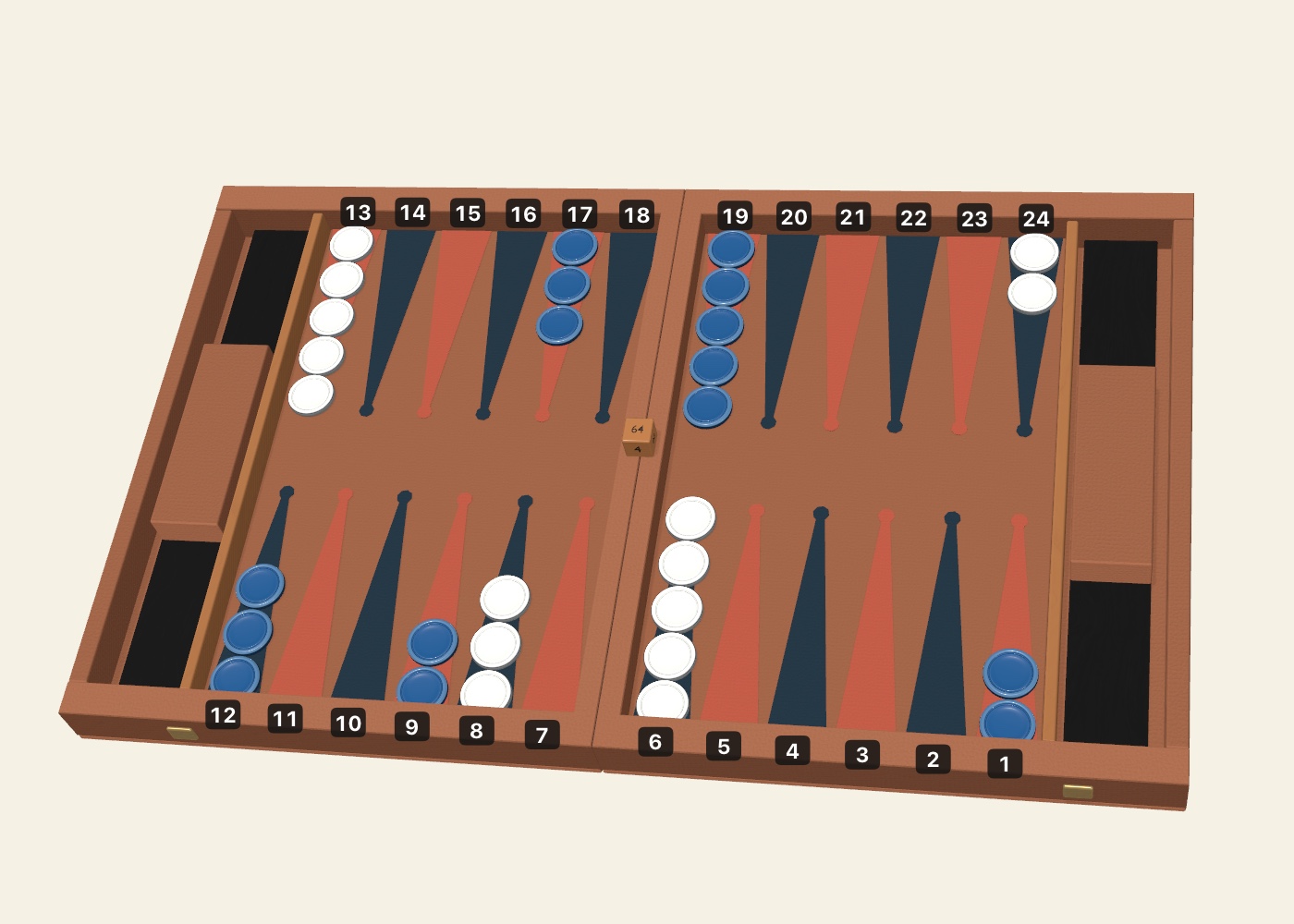
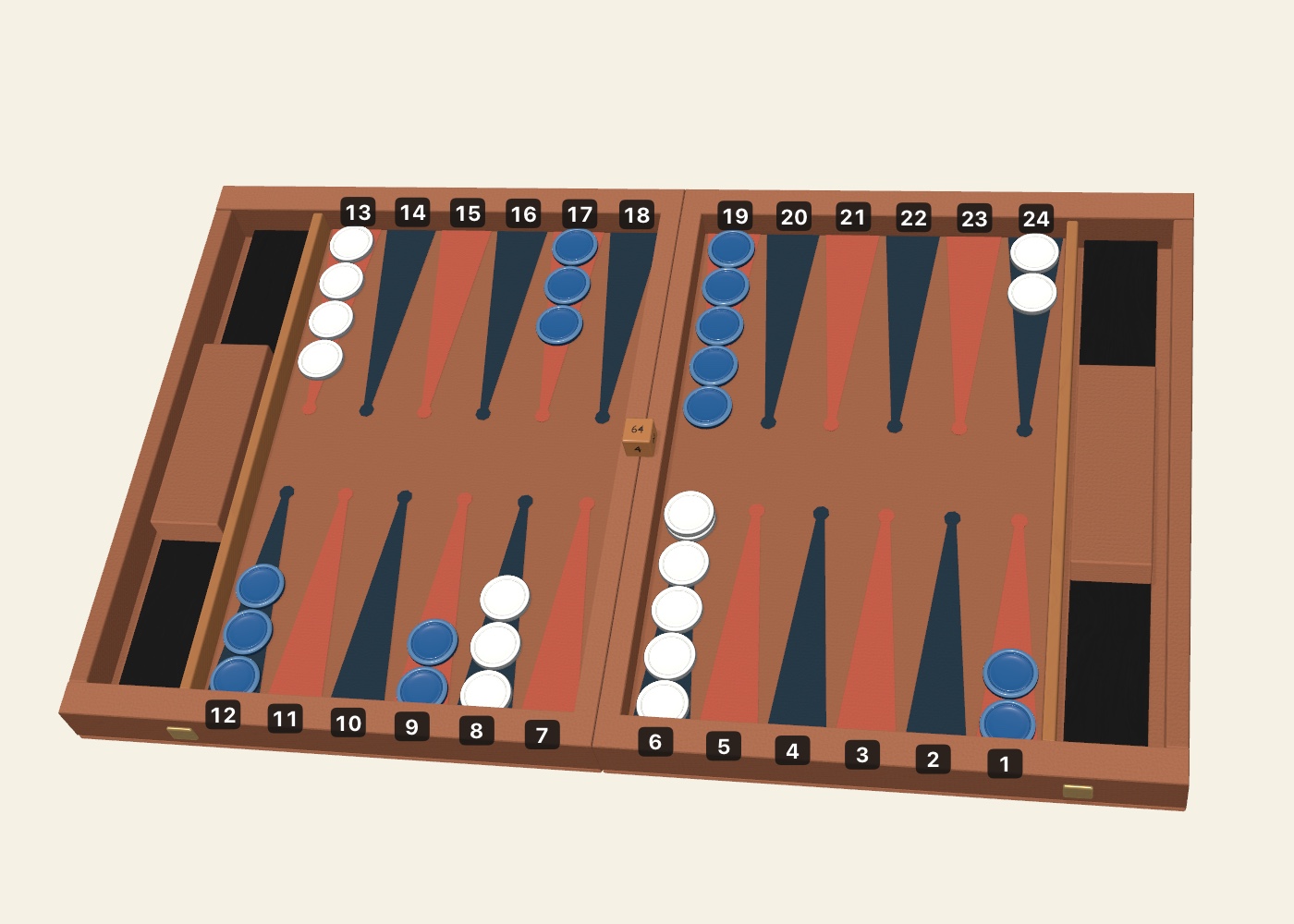
Look at Figure 3. White wants to move a checker from 13 to 6 with a 4 and a 3. Black holds point 9. Playing the 4 first would land on 9, which is illegal. Playing the 3 first lands on the empty 10-point; the 4 then takes the checker from 10 to 6. That route works.
You may choose the order of the dice. Think of a two-die move as two footsteps, with a real place to stand between them.
Figure 3. The same destination, two different routes. The route through 9 is blocked; the route through 10 is open.
Board position
| Point × checkers | Bar | Borne off | |
|---|---|---|---|
| White | 6 × 5, 8 × 3, 13 × 5, 24 × 2 | 0 | 0 |
| Black | 1 × 2, 9 × 2, 12 × 3, 17 × 3, 19 × 5 | 0 | 0 |
Board position
| Point × checkers | Bar | Borne off | |
|---|---|---|---|
| White | 6 × 6, 8 × 3, 13 × 4, 24 × 2 | 0 | 0 |
| Black | 1 × 2, 9 × 2, 12 × 3, 17 × 3, 19 × 5 | 0 | 0 |
Your turn. If both intermediate points were closed, could White move the checker straight from 13 to 6 because the dice total seven?
Explanation. No. Adding the dice does not remove the intermediate landing. At least one legal order is required.