 Backgammon
Part One — Play your first game
Lesson 2 — Set up and start
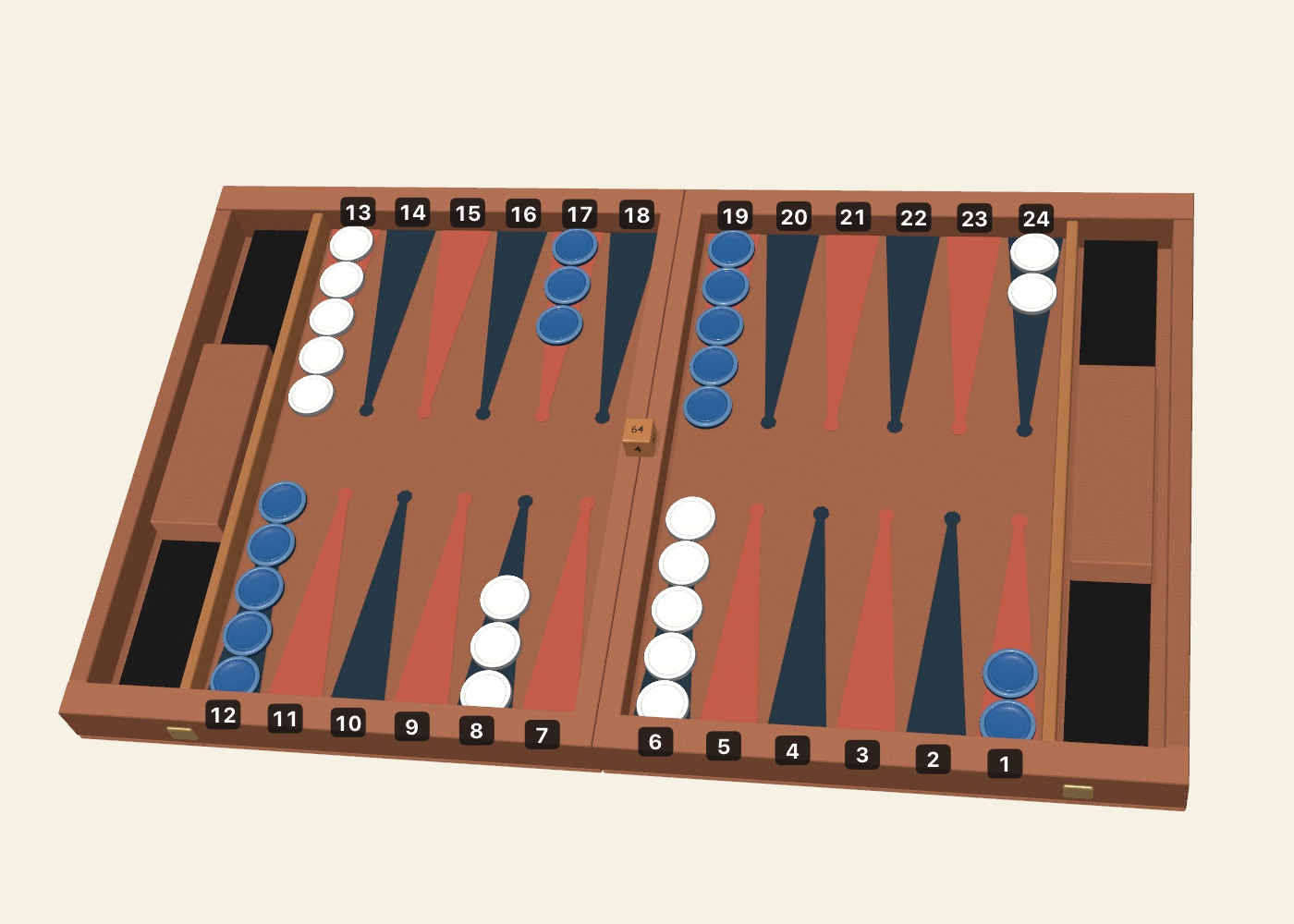
Open the bookWhite starts with two checkers on point 24, five on 13, three on 8, and five on 6. Black has the matching arrangement on the other side: two on 1, five on 12, three on 17, and five on 19.
Count them before you start. Two plus five plus three plus five makes 15.
To decide who begins, each player rolls one die. If the numbers match, both roll again. The player with the higher number starts, using the two numbers already rolled. There is no fresh roll for the opening move.
Suppose White rolls a 4 and Black rolls a 2. White goes first and plays a 4 and a 2. After that turn, Black rolls both dice. The players continue taking turns with two dice each.
The special opening roll cannot be a double: a tie is rolled again. Doubles become possible on subsequent turns.
Figure 2. The starting position. Count the four groups on each side: 2, 5, 3, 5.
Board position
| Point × checkers | Bar | Borne off | |
|---|---|---|---|
| White | 6 × 5, 8 × 3, 13 × 5, 24 × 2 | 0 | 0 |
| Black | 1 × 2, 12 × 5, 17 × 3, 19 × 5 | 0 | 0 |
Your turn. You roll a 2 and your opponent rolls a 5. Who moves, and which numbers do they use?
Explanation. Your opponent starts, using 5 and 2. Both dice contribute to the first turn, even though each player rolled only one of them.
Put this lesson into practice
Check your board against the numbered backgammon setup guide, then reset it from memory.
Keep the printable setup card and beginner rules beside your board for your first game. The kit is available in A4 and US Letter.