Learn
Hitting and entering from the bar in backgammon
See how blots are hit, where to re-enter, when other checkers can move and why hit-and-run is legal in standard backgammon.
You hit an opponent’s single checker—a blot—by landing on its point. Put the hit checker on the bar. On that player’s next turn, they must re-enter through your home board before moving any checker elsewhere. A point with two or more opposing checkers is blocked; it cannot be hit or used for entry.
The distinction between a blot, a blocked point and mandatory re-entry is part of the standard USBGF rules.
A hit is a landing, not a jump
Suppose White moves from 10 to 6 using a 4. A Black blot on 8 is passed over safely. A Black blot on 6 is hit. White lands on 6 and Black goes to the bar; the two colors never share the point.
Holding a point with two checkers protects it from being hit. There is no standard five-checker limit on a point, so an entry may land on a point already occupied by many of your own checkers.
Translate the die into an entry point
Our diagrams always use White’s numbering. White re-enters at the top right, far from its own home:
| Die | White enters on | The same point from Black’s perspective |
|---|---|---|
| 1 | 24 | 1 |
| 2 | 23 | 2 |
| 3 | 22 | 3 |
| 4 | 21 | 4 |
| 5 | 20 | 5 |
| 6 | 19 | 6 |
Black enters on White’s 1–6 instead. The bar is not numbered as an ordinary board point; for White’s entry calculation it is useful to think “25 minus the die.”
One bar checker: use the remaining die after entry
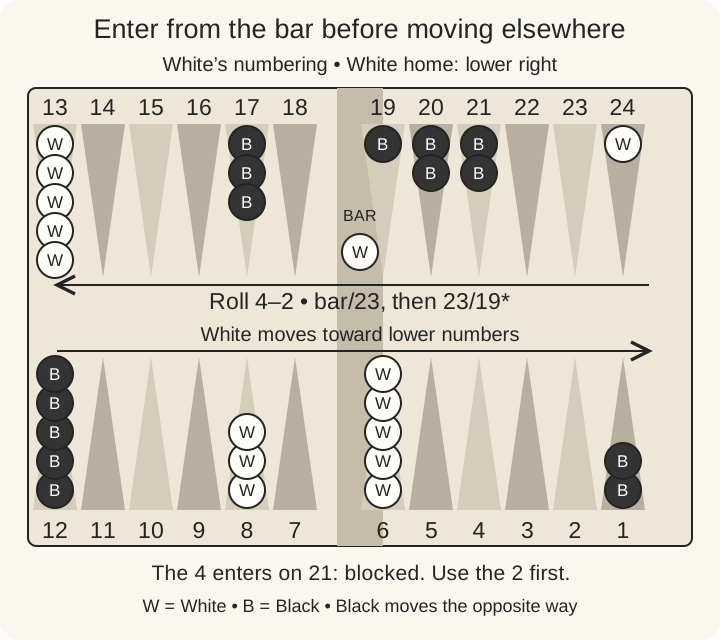
The 4 would enter White on 21, but Black’s two checkers block it. Enter with the 2 on 23. White has no more checkers on the bar, so the 4 is now available for an ordinary move. In the illustrated turn, play bar/23, 23/19*. The asterisk records the hit on 19.
White ends with the entering checker on 19 and Black has one on the bar. Both dice have been used. The rule is to clear the bar before moving elsewhere, not to spend the entire turn entering.
Two bar checkers: do not move the first one onward too soon
Change the example to two White checkers on the bar, with the same entry points blocked and a roll of 4–2. One checker can enter on 23 with the 2. The other cannot enter on 21 with the 4, so White’s turn ends with one still on the bar. Moving the first checker from 23 to 19 would be illegal while its partner is waiting.
If both entries are available, use both numbers to enter. With doubles, each entry uses one of the four moves; after all bar checkers are in, any remaining moves may be played normally. If none of the entries shown by the dice is open, no checker moves that turn. Having all six opposing home points blocked is called being closed out.
Hit-and-run is legal in standard backgammon
You may hit a blot with one die and move the same checker onward with another, including within your own home board. For instance, White on 9 with 4–2 can play 9/5*/3 if Black has one on 5 and point 3 is open. That sequence is legal provided it satisfies the rest of the turn’s dice-use obligations.
Some variants or house rules restrict this. Agree on the game before starting; this library teaches the standard rule, as explained by Backgammon Galore’s hit-and-run answer.
A hit during bearing off delays further removals
If you are hit while bearing off, the checker must re-enter and get all the way home before you can remove another checker. Your already borne-off checkers stay off. Review bearing off with contact and complete-turn dice obligations for the two rules most likely to change an apparent move.