 Backgammon
Part Two — Give your moves a purpose
Lesson 14 — Count the race
Open the bookA pip count measures the total distance your checkers still need to travel to come off the board. For White, multiply the number of checkers on each point by that point's number, then add the results.
Two White checkers on 10 contribute 20 pips. Three on 8 contribute 24. A checker on the bar contributes 25, and a checker already off contributes zero.
Because our numbers stay fixed, Black uses the distance from the other end: a Black checker on point 19 contributes 6 pips, on 20 contributes 5, and so on. The formula for a Black checker on point n is 25 minus n.
In Figure 14, White has two on 10, three on 8, five on 6, three on 4, and two on 2. The count is 20 + 24 + 30 + 12 + 4 = 90. Black has 92.
White is two pips ahead in distance. That is useful information, but it does not tell us who must win. The player on turn, the distribution of checkers, and wasted movement during bearing off all matter. While contact remains, hitting and blocking can matter more than a small racing lead.
Figure 14. Count distance, not stacks. White has 90 pips to go; Black has 92. White is on turn, before rolling.
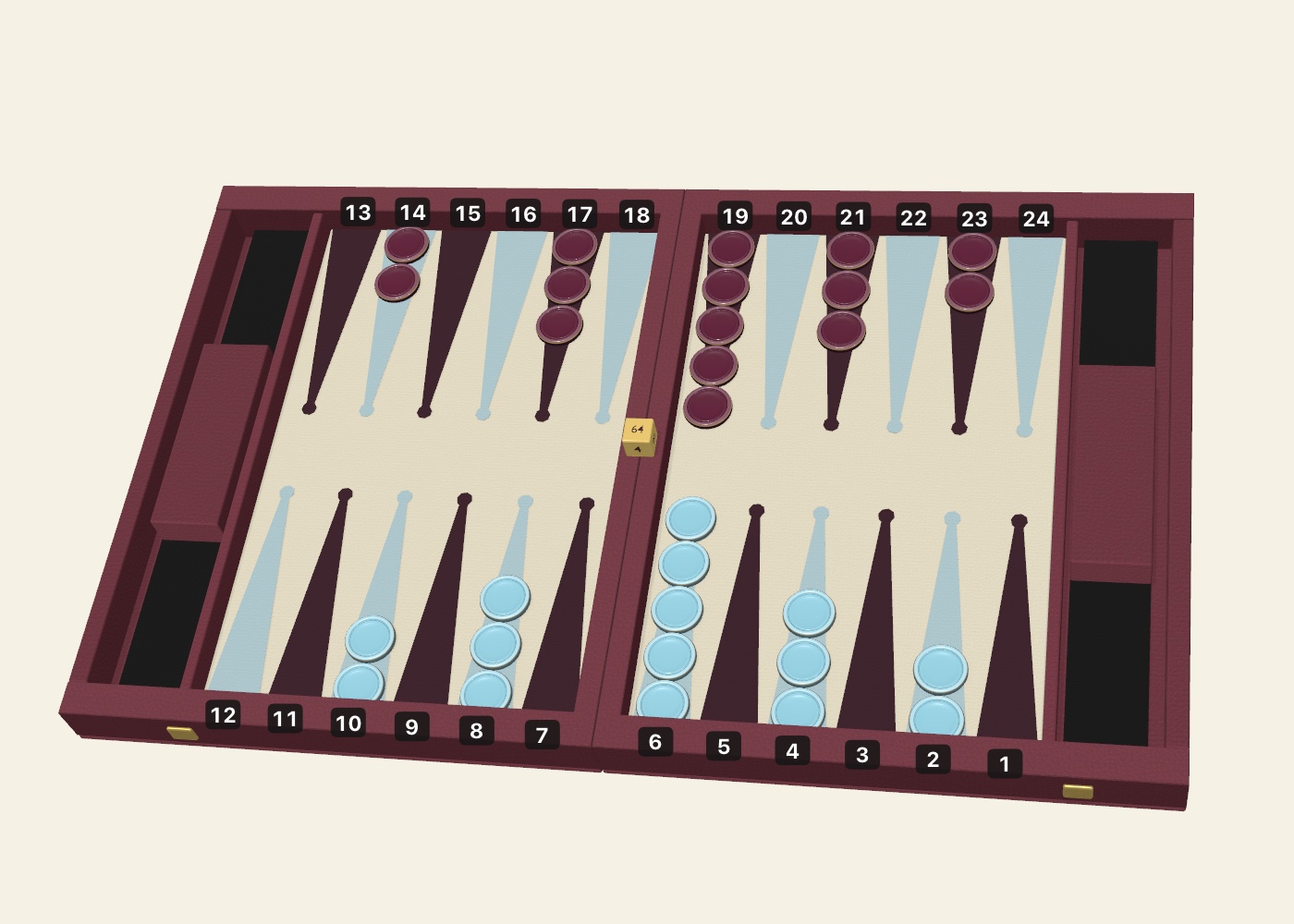
Board position
| Point × checkers | Bar | Borne off | |
|---|---|---|---|
| White | 2 × 2, 4 × 3, 6 × 5, 8 × 3, 10 × 2 | 0 | 0 |
| Black | 14 × 2, 17 × 3, 19 × 5, 21 × 3, 23 × 2 | 0 | 0 |
Your turn. From the starting position, White's count is 2 × 24 + 5 × 13 + 3 × 8 + 5 × 6. What is the total?
Explanation. 167 pips. Black starts with the same distance to travel.
Put this lesson into practice
Work through the pip-counting examples to practise grouping checkers and comparing both players’ totals.
Then try 10 pip-counting positions with worked answers, online or on an A4 or US Letter worksheet. A racing lead is useful information, not a guarantee of winning.