Printables
Backgammon pip-counting practice: free PDF with answers
Practise pip counting with 10 backgammon positions and explained answers. Free A4 and US Letter worksheets, separate answer pages and all exercises online.
Download the PDF
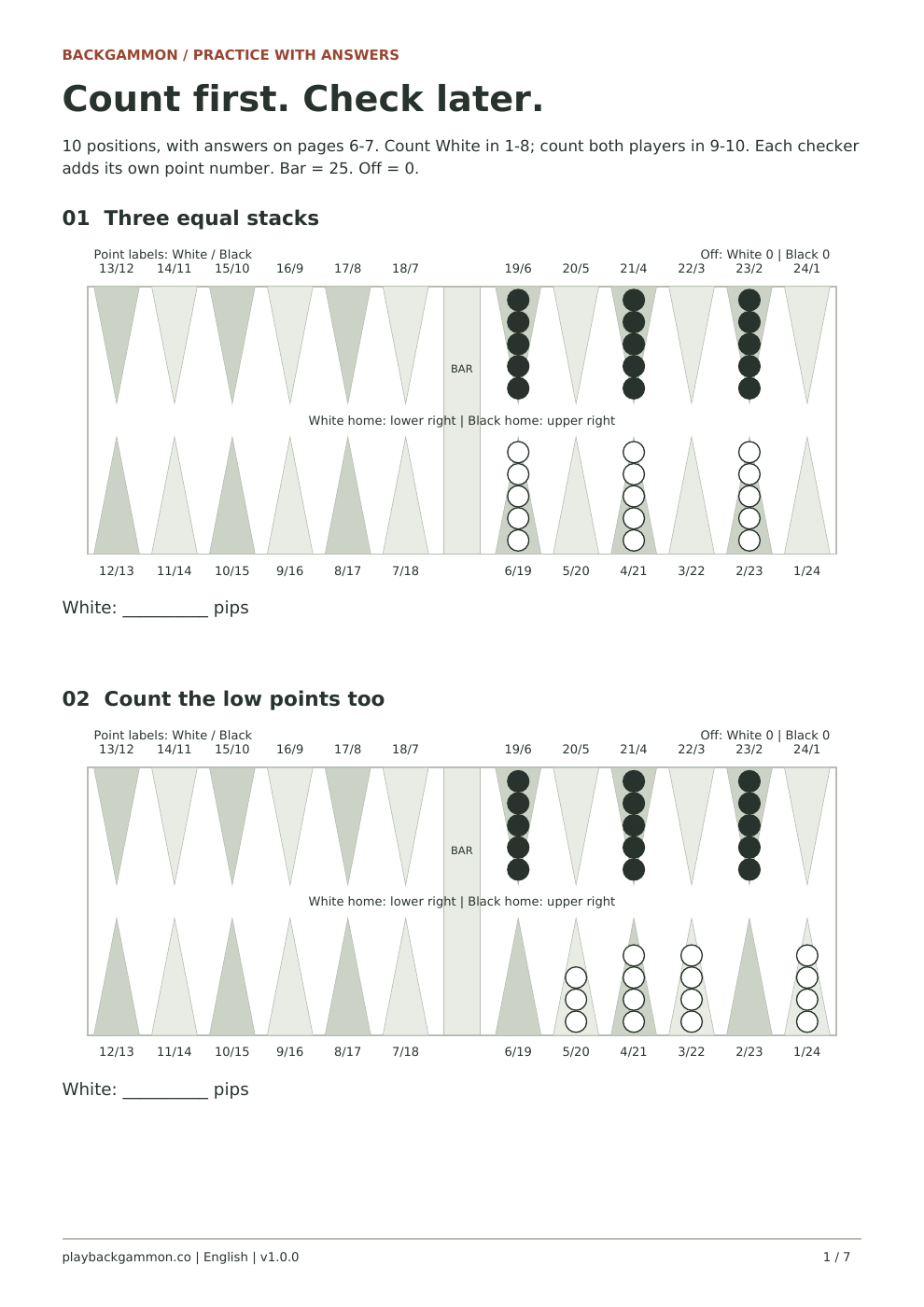 Download practice + answers - A4PDF · A4 · 7 pages · v1.0.0
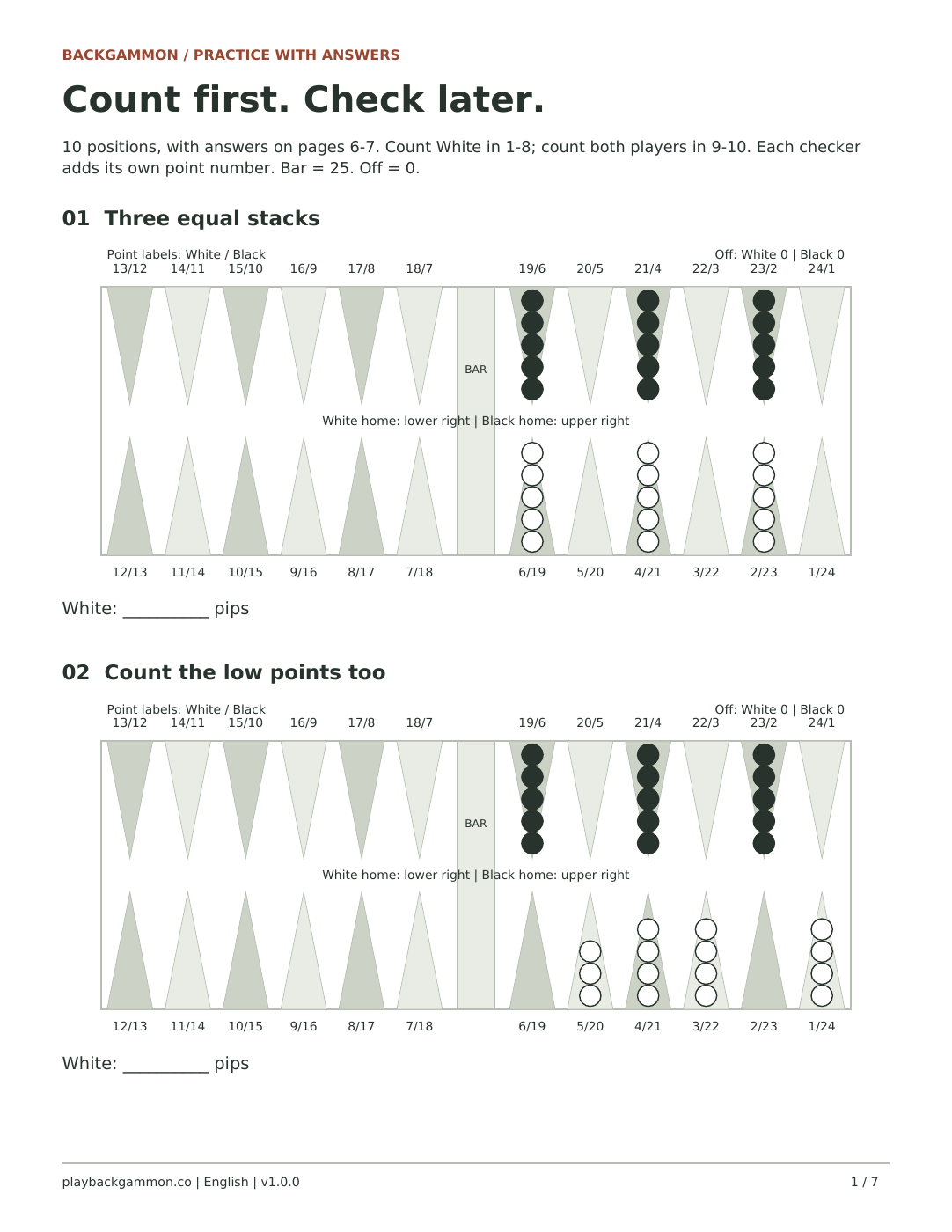 Download practice + answers - US LetterPDF · US-Letter · 7 pages · v1.0.0
Ten original positions to help you count backgammon pips confidently. Download the free seven-page PDF in A4 or US Letter below, or work through every exercise and answer on this page. No signup needed.
What is in the pack?
Five worksheet pages contain two boards each, with space for your answers. The final two pages contain the answer key and arithmetic. Print pages 1-5 for practice; keep pages 6-7 separate until you finish. Use actual size / 100% and the matching paper format. The diagrams also work in black and white.
How to count
Multiply each occupied point number by the number of your checkers there, then add the results. A checker on the bar counts 25; a checker already off counts zero. Each player has 15 checkers including bar and off. See the counting reference or our step-by-step pip-counting guide.
Each point is labelled White / Black. Use the first number for White and the second for Black. Both players count down towards their own 1-point: White finishes at the lower right, Black at the upper right. For example, the point labelled 24/1 is 24 pips away for White but only 1 for Black.
A worked example
Two checkers on your 6-point and three on your 4-point contribute 2 x 6 + 3 x 4 = 24 pips. This is a subtotal, not a complete position: include every other checker to get your full count.
Ten practice positions
Count White in positions 1-8. In positions 9-10, count both players, name the player with the lower raw count and calculate the difference. Try each position before scrolling to the answer key. These are separate positions, not consecutive moves in a game.
1. Three equal stacks
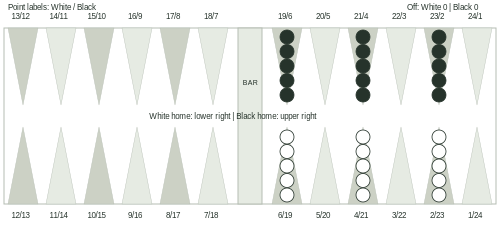
White - point: checkers. 6: 5, 4: 5, 2: 5. Bar: 0. Off: 0.
Black - point: checkers (Black's own numbers). 6: 5, 4: 5, 2: 5. Bar: 0. Off: 0.
Your answer: White ___ pips.
2. Count the low points too
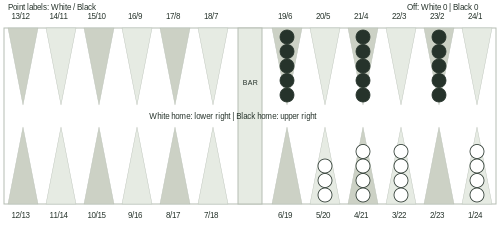
White - point: checkers. 5: 3, 4: 4, 3: 4, 1: 4. Bar: 0. Off: 0.
Black - point: checkers (Black's own numbers). 6: 5, 4: 5, 2: 5. Bar: 0. Off: 0.
Your answer: White ___ pips.
3. Build small groups
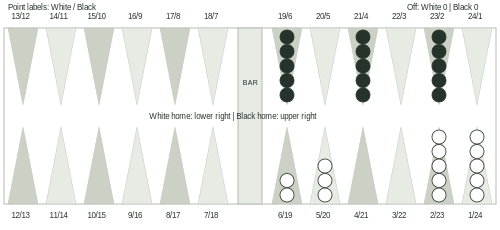
White - point: checkers. 6: 2, 5: 3, 2: 5, 1: 5. Bar: 0. Off: 0.
Black - point: checkers (Black's own numbers). 6: 5, 4: 5, 2: 5. Bar: 0. Off: 0.
Your answer: White ___ pips.
4. Across the whole board
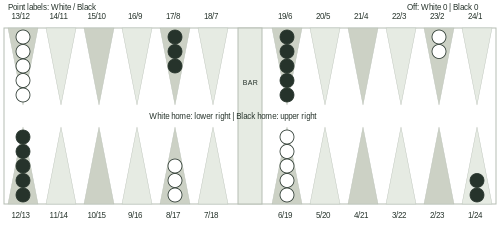
White - point: checkers. 23: 2, 13: 5, 8: 3, 6: 5. Bar: 0. Off: 0.
Black - point: checkers (Black's own numbers). 24: 2, 13: 5, 8: 3, 6: 5. Bar: 0. Off: 0.
Your answer: White ___ pips.
5. Five separate stacks
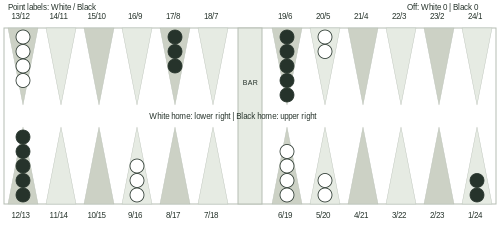
White - point: checkers. 20: 2, 13: 4, 9: 3, 6: 4, 5: 2. Bar: 0. Off: 0.
Black - point: checkers (Black's own numbers). 24: 2, 13: 5, 8: 3, 6: 5. Bar: 0. Off: 0.
Your answer: White ___ pips.
6. Check the middle points
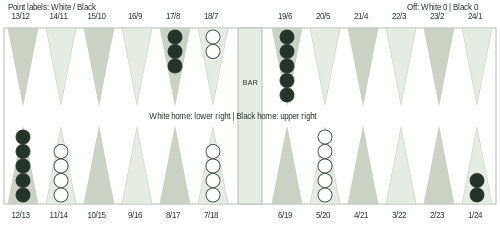
White - point: checkers. 18: 2, 11: 4, 7: 4, 5: 5. Bar: 0. Off: 0.
Black - point: checkers (Black's own numbers). 24: 2, 13: 5, 8: 3, 6: 5. Bar: 0. Off: 0.
Your answer: White ___ pips.
7. One checker on the bar
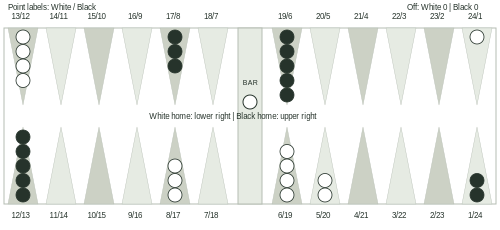
White - point: checkers. 24: 1, 13: 4, 8: 3, 6: 4, 5: 2. Bar: 1. Off: 0.
Black - point: checkers (Black's own numbers). 24: 2, 13: 5, 8: 3, 6: 5. Bar: 0. Off: 0.
Your answer: White ___ pips.
8. Six checkers already off
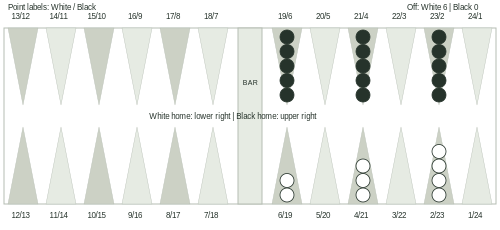
White - point: checkers. 6: 2, 4: 3, 2: 4. Bar: 0. Off: 6.
Black - point: checkers (Black's own numbers). 6: 5, 4: 5, 2: 5. Bar: 0. Off: 0.
Your answer: White ___ pips.
9. Compare both home boards
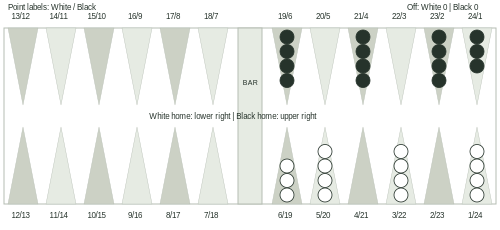
White - point: checkers. 6: 3, 5: 4, 3: 4, 1: 4. Bar: 0. Off: 0.
Black - point: checkers (Black's own numbers). 6: 4, 4: 4, 2: 4, 1: 3. Bar: 0. Off: 0.
Your answer: White ___ pips. Black ___ pips. Lower count ___; difference ___ pips.
10. A close race
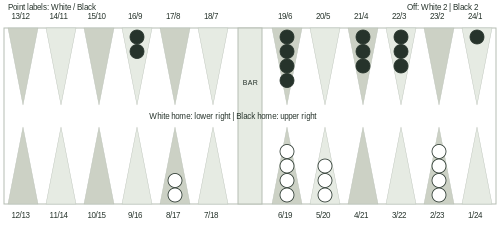
White - point: checkers. 8: 2, 6: 4, 5: 3, 2: 4. Bar: 0. Off: 2.
Black - point: checkers (Black's own numbers). 9: 2, 6: 4, 4: 3, 3: 3, 1: 1. Bar: 0. Off: 2.
Your answer: White ___ pips. Black ___ pips. Lower count ___; difference ___ pips.
Answer key with explanations
Raw pip counts measure remaining distance. They do not, on their own, tell you the best move, winning probability or whether to double. Even a pure race depends on checker distribution and whose turn it is.
Answer 1: Three equal stacks
White: 5 x 6 + 5 x 4 + 5 x 2 = 60 pips.
Each stack has five checkers: 5 x (6 + 4 + 2) = 60.
Answer 2: Count the low points too
White: 3 x 5 + 4 x 4 + 4 x 3 + 4 x 1 = 47 pips.
Group the four-checker stacks: 4 x (4 + 3 + 1) = 32. Add 15 from the 5-point.
Answer 3: Build small groups
White: 2 x 6 + 3 x 5 + 5 x 2 + 5 x 1 = 42 pips.
The five checkers on 2 and the five on 1 contribute 15 together. The other stacks add 27.
Answer 4: Across the whole board
White: 2 x 23 + 5 x 13 + 3 x 8 + 5 x 6 = 165 pips.
This is two pips below the usual starting count of 167: both back checkers are on 23 instead of 24.
Answer 5: Five separate stacks
White: 2 x 20 + 4 x 13 + 3 x 9 + 4 x 6 + 2 x 5 = 153 pips.
Add the two far stacks first: 40 + 52 = 92. The remaining three stacks add 61.
Answer 6: Check the middle points
White: 2 x 18 + 4 x 11 + 4 x 7 + 5 x 5 = 133 pips.
The four-checker stacks contribute 4 x (11 + 7) = 72. Add 36 and 25.
Answer 7: One checker on the bar
White: 1 x 24 + 4 x 13 + 3 x 8 + 4 x 6 + 2 x 5 + 1 x 25 = 159 pips.
The 14 checkers on points total 134. Add 25 for the checker on the bar, not 24.
Answer 8: Six checkers already off
White: 2 x 6 + 3 x 4 + 4 x 2 + 6 x 0 = 32 pips.
The six borne-off checkers contribute zero. Count only the nine checkers still on points.
Answer 9: Compare both home boards
White: 3 x 6 + 4 x 5 + 4 x 3 + 4 x 1 = 54 pips.
Black: 4 x 6 + 4 x 4 + 4 x 2 + 3 x 1 = 51 pips.
Black has the lower raw count by 3 pips. Use Black's own point numbers, not White's labels.
Answer 10: A close race
White: 2 x 8 + 4 x 6 + 3 x 5 + 4 x 2 + 2 x 0 = 63 pips.
Black: 2 x 9 + 4 x 6 + 3 x 4 + 3 x 3 + 1 x 1 + 2 x 0 = 64 pips.
White has the lower raw count by 1 pip. Both players have two checkers off; those add zero.
Keep practising
If you missed a count, check direction first, then recount the checkers, then check your multiplication. For more help, read the counting guide and see how bearing off works. For a first-game reference, use the free setup, rules and scorecard kit.
Printing and sharing
You may print and share this original pack unchanged for personal, family, classroom and club practice. Keep the attribution. No signup, payment or app installation is required. The same exercises and explanations are available above as readable webpage text.