Printables
Backgammon opening chart: free PDF
Free English opening-moves PDF in A4 and US Letter: all 15 rolls, a worked board and practice questions. Read the same chart online.
Download the PDF
 Download opening chart - A4PDF · A4 · 2 pages · v1.0.0
- Download opening chart - US-LetterPDF · US-Letter · 2 pages · v1.0.0
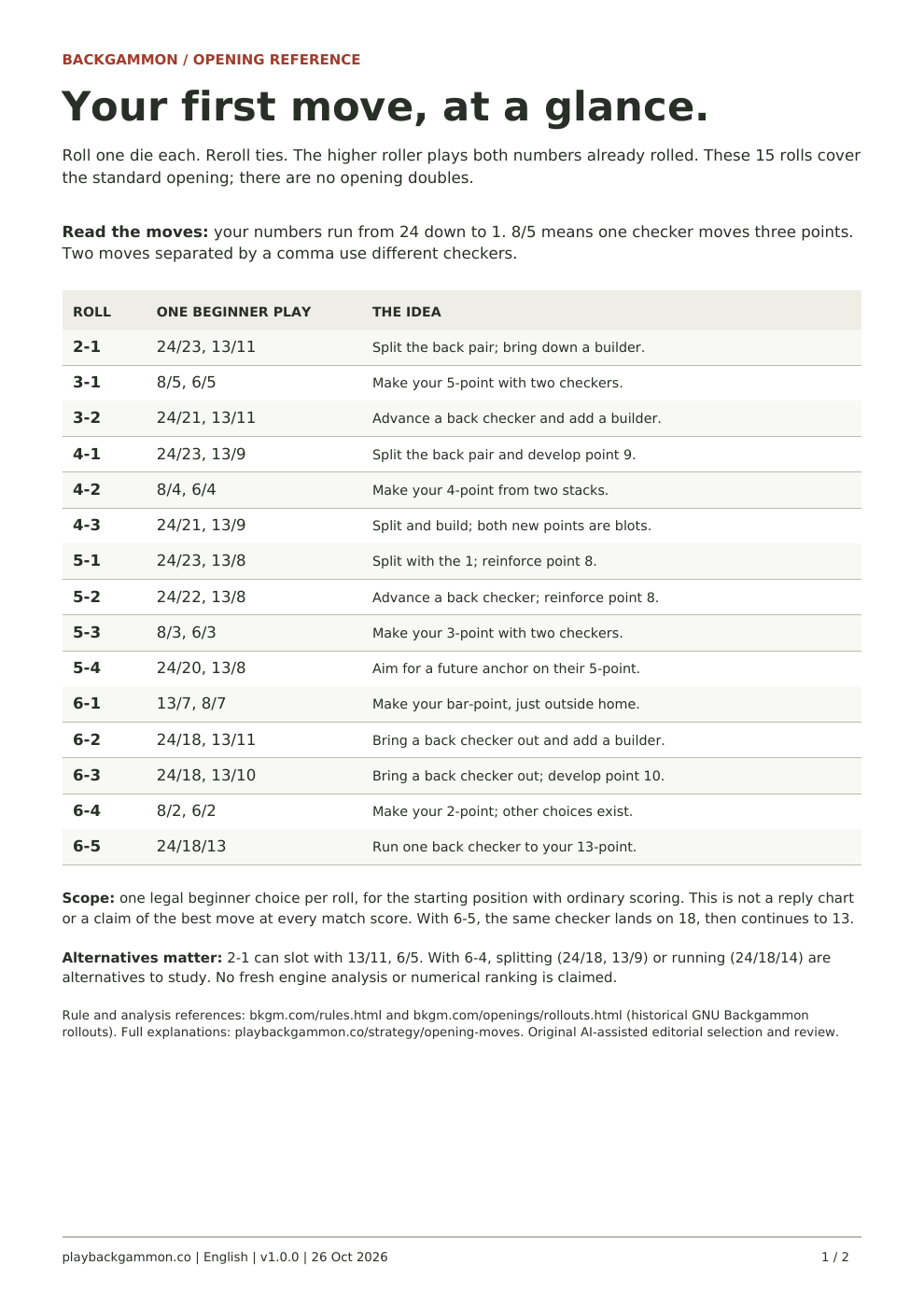
Download a free English backgammon opening-moves chart in A4 or US Letter. Each two-page PDF contains all 15 non-double opening rolls, one legal beginner play per roll, a worked 3-1 board and three questions with answers. Choose the paper size that matches your printer and print at actual size (100%).
What is in the download?
Page 1 is a compact table reference for the first move. Page 2 explains 8/5 and 6/5 with an original board illustration and checks your understanding of points, anchors and pip counts. You can print only page 1 if you want a single reference sheet beside the board.
The chart applies to the starting position under ordinary scoring. It does not cover replies after an opponent has moved, or prescribe the best play at every match score. These are reviewed beginner choices, not a fresh engine analysis.
Read the chart here
The same chart is available below as HTML text. For the opening, each player rolls one die. Reroll ties; the higher roller uses both numbers already rolled. There are no doubles on the standard opening roll.
Numbers are your own point numbers, moving from 24 towards 1. A slash describes a move: 8/5 means one checker moves three points. With 6-5, 24/18/13 is one checker making two legal moves, first with the 6 and then with the 5.
| Roll | One beginner play | Idea |
|---|---|---|
| 2-1 | 24/23, 13/11 | Split the back pair; bring down a builder. |
| 3-1 | 8/5, 6/5 | Make your 5-point with two checkers. |
| 3-2 | 24/21, 13/11 | Advance a back checker and add a builder. |
| 4-1 | 24/23, 13/9 | Split the back pair and develop point 9. |
| 4-2 | 8/4, 6/4 | Make your 4-point from two stacks. |
| 4-3 | 24/21, 13/9 | Split and build; both new points are blots. |
| 5-1 | 24/23, 13/8 | Split with the 1; reinforce point 8. |
| 5-2 | 24/22, 13/8 | Advance a back checker; reinforce point 8. |
| 5-3 | 8/3, 6/3 | Make your 3-point with two checkers. |
| 5-4 | 24/20, 13/8 | Aim for a future anchor on their 5-point. |
| 6-1 | 13/7, 8/7 | Make your bar-point, just outside home. |
| 6-2 | 24/18, 13/11 | Bring a back checker out and add a builder. |
| 6-3 | 24/18, 13/10 | Bring a back checker out; develop point 10. |
| 6-4 | 8/2, 6/2 | Make your 2-point; other choices exist. |
| 6-5 | 24/18/13 | Run one back checker to your 13-point. |
How to practise with a physical board
Set up the starting stacks, choose one roll from the chart, and play it. Say what the move is trying to do: make a point, split your back checkers, bring down a builder or run towards safety. Count 15 checkers afterwards, then restore the starting board for the next roll.
For 3-1, move one checker from 8 to 5 and another from 6 to 5. You have made your 5-point, with two checkers still on 8 and four on 6. Your pip count is now 163. A single checker on the opponent's 5-point would not yet be an anchor; the glossary explains the difference.
Some rolls have reasonable alternatives. With 2-1, 13/11 and 6/5 slots your 5-point. With 6-4, 24/18 and 13/9 splits and builds, while 24/18/14 runs. Read the full opening guide for assumptions, alternatives and historical analysis references.
Paper sizes and version
Both files are English, version 1.0.0, reviewed on 26 October 2026. A4 measures 210 by 297 mm; US Letter measures 8.5 by 11 inches. The moves and explanations are identical in both. PDF text is selectable; the board illustration is an image. Use the HTML chart above when you prefer browser text and navigation.
For setup, basic rules and a scorecard in one download, use the separate beginner starter kit.